
I Am Obsolete
And that's fine by me

If you had to travel 26.2 miles as fast as possible, how would you do it?
You could grab a bike or jump in a car and cover that distance in no time—which is pretty unremarkable.
That’s why every year, millions choose to lace up their shoes and embrace the challenge of a marathon—training tirelessly to cover that same distance on their own two feet.
Why do they do it? Because the value isn’t in simply covering the distance—it’s in the journey itself.
Every runner’s path, from the starting line to the finish, is uniquely shaped by their effort and goals.
But this isn’t just about running. It’s a powerful metaphor for doing just about anything.
Over the past few weeks, I’ve grappled with the brutal truth: in many ways, I am already obsolete.
As a programmer and as an artist, AI-powered tools are already outperforming me in a lot of tasks and they’re getting more powerful every day, far outpacing my ability to improve as a programmer or artist.
Hell, AI can generate artwork so good that it’s nearly indistinguishable from centuries-old masterpieces.
But the comforting truth I’ve also come to realize is that no matter how good the technology gets, you can’t decouple the process from the final product.
Sci-fi writer and philosopher Ted Chiang put it best when he argued that art isn’t just about the end result—it’s about every choice, every struggle, and every bit of context that goes into its creation:
Many people would have you believe that the process of making art and the end result can be easily separated, but I don’t believe they can be.
I was talking with someone who is very excited about AI-generated imagery, and she said, “Let’s imagine, for the sake of argument, that AI can make better art than humans. In that scenario, do you think that we should reject AI art simply to protect the livelihood of human artists?”
I responded, “I’m not going to grant you that premise, because that is the question under debate. You are framing the hypothetical in a way that assumes the conclusion.” I don’t believe it’s meaningful to say that something is better art absent any context of how it was created.
Art is all about context. It’s not an activity like tightening bolts, where I don’t really care whether someone used a conventional wrench or a pneumatic wrench, as long as the bolts are tight.
Sure, AI offers ways to complete previously difficult tasks with ease.
But true beauty and craftsmanship lies within the grueling process in which art is made. Not just visual art, but art of any form like music, culinary pursuits, writing, etc. etc. etc.
So what is AI’s place in art world?
AI tools will enable new forms of art and capabilities altogether. Specifically, I believe immersive and interactive experiences will flourish with this powerful technology that can react to user input in real time.
But it’s important to note that traditional art will not fall by the wayside because it can be made faster and cheaper by some smart ass computer for the same reasons we still celebrate running 26.2 miles instead of driving that same distance.
It will enable artists to go beyond and experiment with different mediums and art experiences altogether.
It’s a call to evolve.
With Day by Data, I view AI not as a replacement, but as a powerful tool in the creative toolbox that enables new things.
My work is about forging new paths with data and art. As more models become available, I look to AI to better understand how I can make connections and inferences about a user based on disparate data points.
For example, I might use it to tie together their activity data with their music listening data to tell an exciting story of how my step data is fueled by your love of punk rock music.
This new technology is humbling and oftentimes pretty scary to see make such massive jumps in capabilities in a few months.
But every time I feel obsolete, I lace up my running shoes, knock out a few miles, and remind myself that my feet (and brain) can take me anywhere I want to go—and that process, even if it takes longer, is still worth celebrating.
What I did This Week — Onboarding
Finally released a new version of Day by Data with widget support for Apple Health and Spotify! One particular feature I loved building was this new conversational onboarding. None of this is AI, it’s all preset conversations.
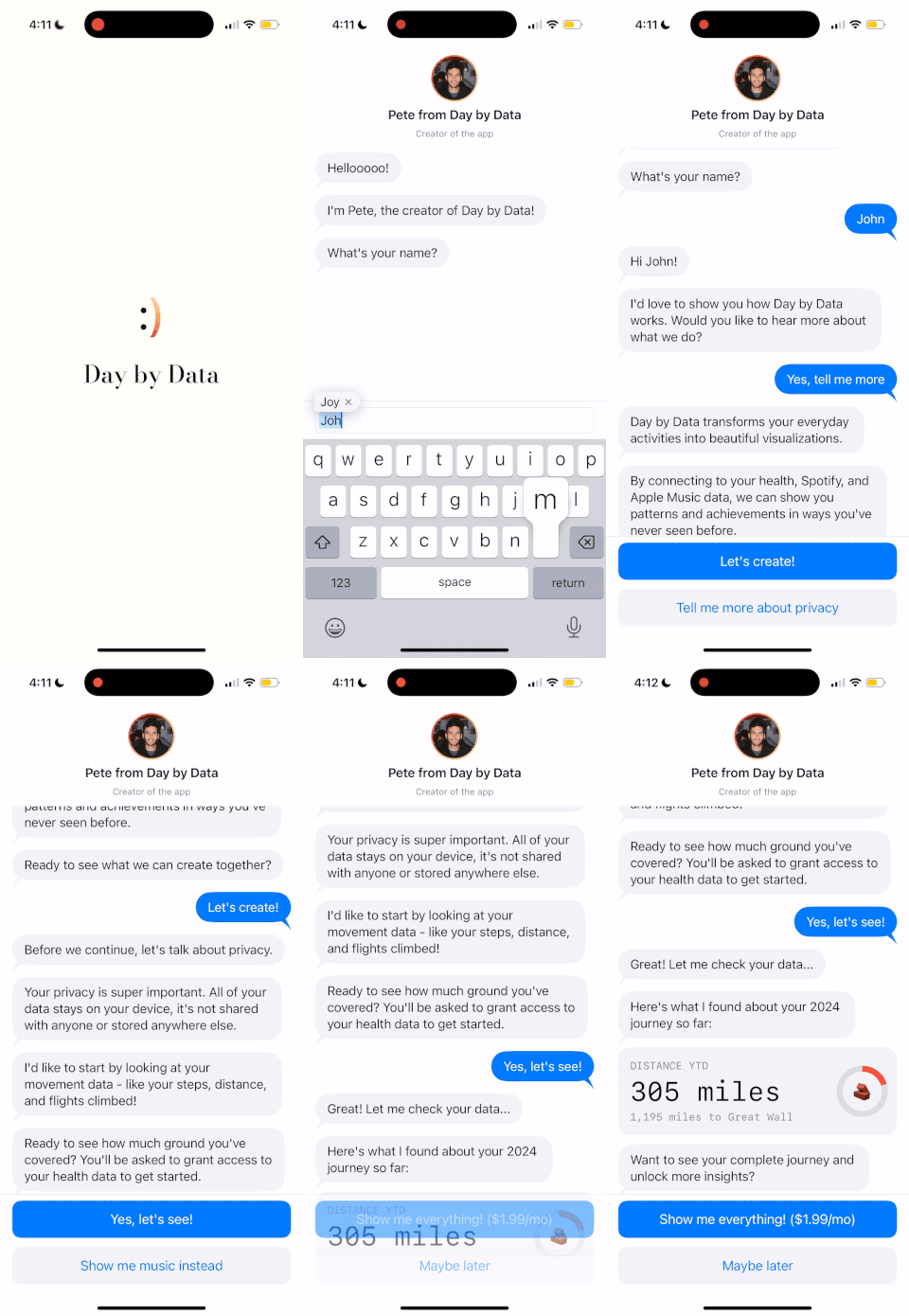
The idea is that it should feel like I am onboarding you onto the app, not another stale onboarding process designed to maximize conversions.
There is a lot more I want to refine and evolve with this concept, continuing to mimic iMessage with features like adding reactions to messages and integrating other parts of the app features.
While this doesn’t use AI, there is certainly a compelling case for exploring your personal data conversationally with AI help to look at the queries.
Art I Loved This Week —
Came across an older twitter post from Poetic Engineering on twitter of blending music / sound and artwork.
Link to the video here to get the full effect with music and live effects.
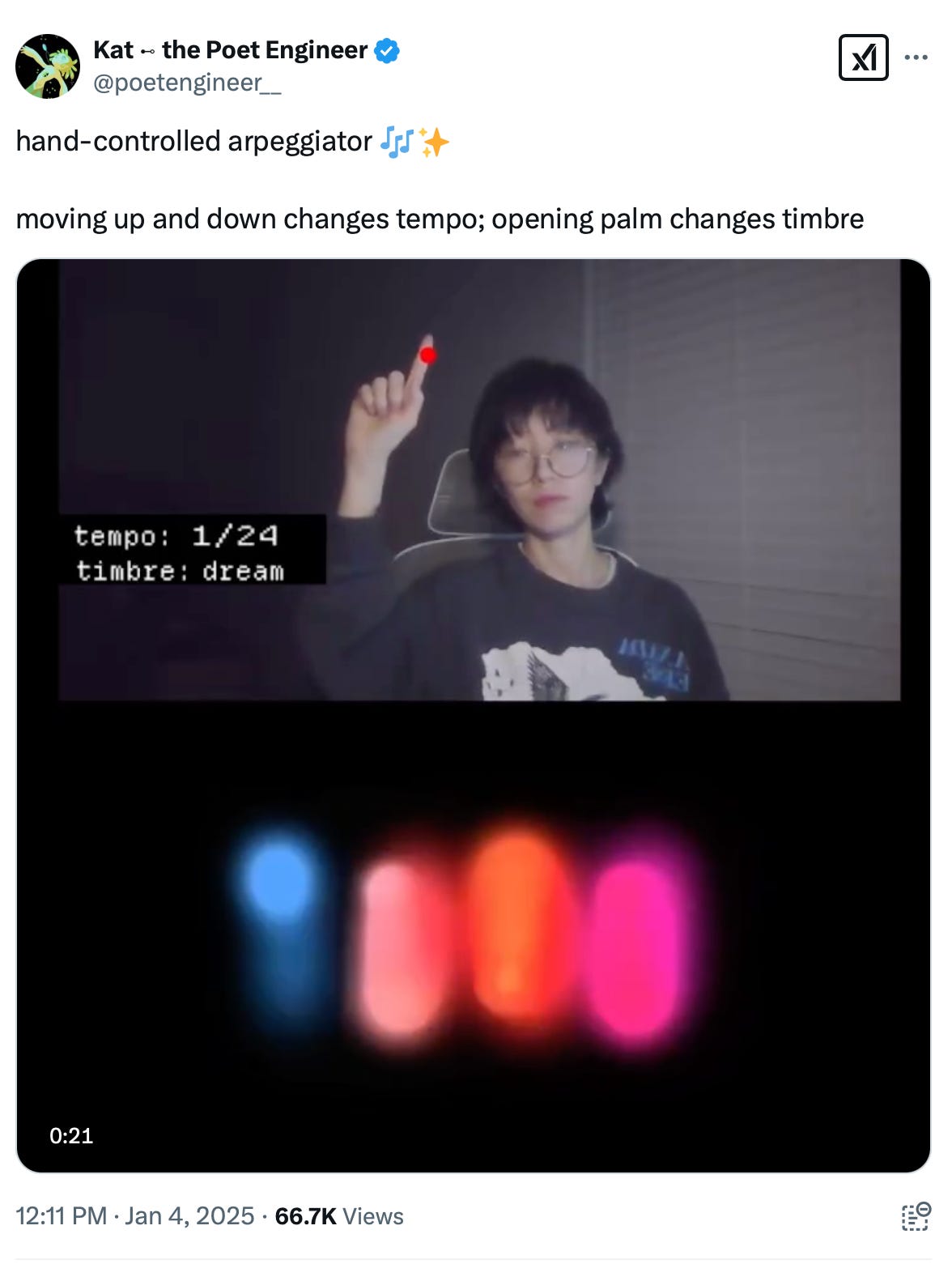
Kat uses TouchDesigner to create different art pieces and a media pipe plugin to track gestures. I really love her approach to sharing her experiments in progress and the tools she uses.
This was a really cool premise and something I want to explore, blending live music with TouchDesigner and data, in this case gesture data.
This is also a perfect example of AI and ML expanding what’s possible for art.
Great onboarding design. Definitely feels like you're personally welcoming me to the app.